
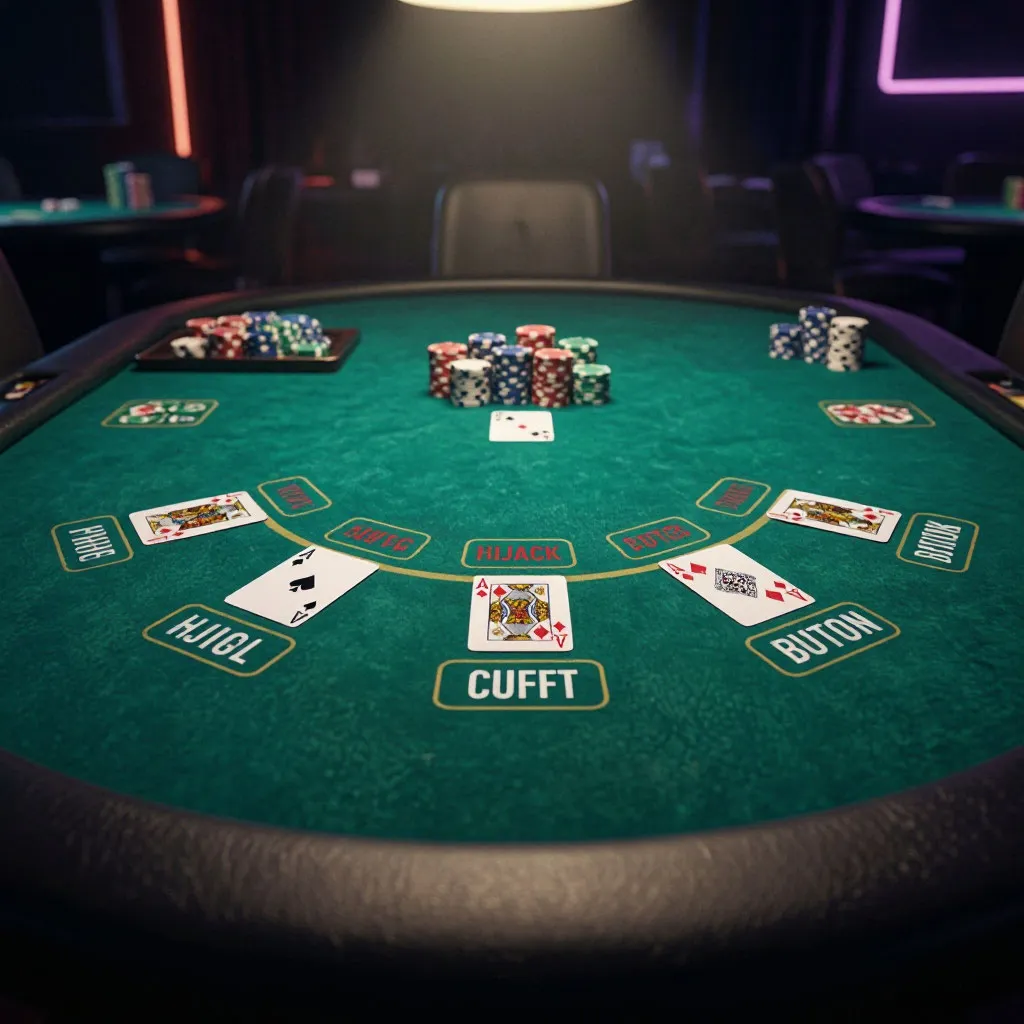
Sit down at any poker table and the first thing a good player checks is not the cards — it is the seat. Position determines who acts first, who acts last and who gets to see everyone else’s decision before committing chips. That single fact shapes strategy more than almost anything else in poker: the same two hole cards can be a raise from the button and a fold from under the gun. The names beginners hear — UTG, hijack, cutoff, button — are simply labels for the order in which players act, and once the order is understood, every name on the felt stops being jargon and starts being information.
Why position is the backbone of poker strategy
Acting last is an advantage because information flows toward you. Every player who acts before you either commits money, raises, or folds, and each of those actions narrows the range of hands they could hold. By the time the action reaches a late seat, the player there has watched most of the table speak and can make a far more informed decision than anyone who already acted blind. Acting early reverses the problem: an under-the-gun decision is made with maximum uncertainty and maximum players still waiting behind to react.
This asymmetry is not a theory but a measurable fact of the game. Screens of millions of hands consistently show that profit in Texas hold’em flows toward the later seats, with the button and cutoff earning dramatically more per hand than any other position, and the blinds and early positions losing money even for solid players. Good players respond to this by playing far more hands from late seats and far fewer from early ones, which is why every strategy discussion eventually arrives at the same question: where are you sitting?
The full cast of positions at the table
Before ranges and tactics make sense, the physical layout has to be mapped. Names vary slightly between games and formats, but a nine-handed hold’em table follows a consistent pattern, and each seat carries its own character. Working clockwise from the blinds gives the complete picture:
- Small blind (SB) — the seat immediately left of the dealer; posts half the blind and acts first on every post-flop street, the worst combination in the game.
- Big blind (BB) — posts the full blind, gets a discount to see the flop, but still acts first after it and faces pressure from every raise.
- Under the gun (UTG) — first to act after the blinds pre-flop; the most constraining seat at the table because everyone behind is still alive.
- Middle positions (MP) — the seats between UTG and late position, sometimes labelled UTG+1 and UTG+2 or lojack; gradually more playable as more players fold ahead.
- Hijack (HJ) — two seats before the button; named for its ability to steal pots with a raise before the stronger late seats can respond.
- Cutoff (CO) — one seat before the button; a premium seat that often opens wide since only two players remain to act behind.
- Button (BTN) — the dealer seat; acts last on every post-flop street and earns the nickname the best seat in poker for good reason.
The button deserves a closer look because of how the dealer rotation works. In home games the button physically deals the cards, while in cardrooms a flat disc marks the nominal dealer and a professional dealer handles the deck. Either way, the marker moves one seat clockwise after every hand, which means every player rotates through every position in turn. Nobody is permanently stuck in the blinds or permanently blessed with the button — but over the course of a session, the money still flows toward whoever is on it at the right moments.
How the order of action runs through a hand
The positions only come alive when you follow them through a complete betting round, because acting order does not stay fixed. Pre-flop and post-flop order mirror each other, and that reversal is precisely why the blinds are such losing seats. The sequence works like this:
- Pre-flop, action begins with the player left of the big blind (UTG) and moves clockwise; the blinds act last, and if nobody raises, the big blind gets an option to raise or check.
- Post-flop, the order flips: the first active player to the left of the button acts first, meaning the blinds and early positions are forced to commit before seeing what anyone else does.
- On every subsequent street, the same post-flop order applies, so the button retains its last-say advantage through the turn and river.
The consequence of that flip is subtle but decisive. Pre-flop, the blinds act late and can lean on that; after the flop, they act early on every single street while the button acts last on every single street. A seat that looked acceptable before the cards were dealt becomes the hardest seat to play once community cards hit the table. This is why disciplined players defend the blinds carefully but never confuse their blind option with a positional advantage.
Position by position: what each seat demands
Each seat has its own expected behaviour, and the differences are stark enough that a solid player could almost play the table seat by seat. The comparison below condenses the practical reality of every major position into the approach it demands.
| Position | Acts | Hand requirements | Typical style |
|---|---|---|---|
| Small blind | First post-flop | Very tight; fold most hands | Defend selectively, avoid traps |
| Big blind | Late pre-flop, first post-flop | Defend wider, but carefully | Call raises with strong range |
| UTG | First pre-flop | Only top-tier holdings | Raise few hands, almost never limp |
| Hijack | Late middle | Solid but flexible range | Open wider, watch the cutoff |
| Cutoff | Second to last | Much wider, attack the blinds | Isolate limpers, steal often |
| Button | Last post-flop | Widest range at the table | Play aggressively, attack everyone |
| Blinds combined | — | Highest long-term losses | Fight back with tight, strong play |
What stands out from this breakdown is how sharply the requirements change across a few seats. Moving from UTG to the button can triple the number of hands worth playing, and that gap is the visible face of the informational advantage described earlier. Players who apply an average strategy across all seats — the same range everywhere — leak money from the early positions that their late-position wins cannot fully cover.
Playing the seats that matter most
Under the gun: surviving the toughest seat
UTG forces discipline. With eight or more players waiting to act, any hand you raise must be able to withstand being three-bet, called by stronger holdings and played out of position for the rest of the hand. Premium pairs, big aces and strong broadway cards form the core of a UTG range, and folding marginal suited connectors here is not weakness but arithmetic. The players who limp into pots from early seats are usually the same ones bleeding chips over a long session.
The hijack and cutoff: the stealer’s corridor
The two seats before the button exist in a sweet spot: most of the table has folded, yet only one or two strong seats remain to punish a raise. The hijack can open a solid range and often picks up the blinds uncontested; the cutoff goes further, attacking the blinds directly and setting up the classic dynamic of cutoff versus button for initiative. Both seats reward awareness of what the players behind you are like — aggressive three-bettors demand tighter opens, while passive callers invite wider, more relentless raising.
The button: where the money is made
On the button, you act last on every street after the flop, which means you control the size of the pot, can value-bet thinly when checked to, can bluff when everyone shows weakness and can see a cheap flop with speculative hands. The standard playbook is to raise a very wide range, attack the blinds and carry the initiative post-flop. The main risk is complacency: the button wins so often by default that careless players give back their edge with poorly sized bets, while sharp players treat every button hand as a chance to pressure a specific opponent.
The blinds: minimising the damage
Nobody profits long-term from the blinds, but losses there differ dramatically between players. The big blind gets the right price to defend a wide range against a single raise, while the small blind suffers the combination of a partial blind, worst post-flop position and the need to beat two players. The pragmatic approach is to defend the big blind with a rational calling range, avoid the small blind except with genuine hands, and never let a blind-feeling obligation drag you into calling raises with junk.
The habits that turn position knowledge into profit
Understanding the labels is only the start; the edge comes from habits applied hand after hand. These are the ones that consistently separate positional awareness from positional theory:
- Read your seat before your cards. Look at position first, then decide which hands are in play — never the reverse.
- Adjust to the players behind you. The value of a raise from the cutoff depends entirely on how the button and blinds respond to aggression.
- Count the players yet to act, not the ones already gone. Two folds from weak players mean less than three strong players still waiting.
- Fight for the blinds with purpose. Wide, well-timed attacks from the cutoff and button collect the dead money that keeps late seats profitable.
- Protect yourself in position. When you call a raise out of the blinds, expect to play every street without the last say, and size your calling range accordingly.
Each of these habits is really a version of the same discipline: treating position as information about who speaks after you. A raise from early position is a promise to play big pots with incomplete information; a raise from the button is an invitation to decide things last.
Where position theory goes next
Once the seat map is second nature, deeper layers appear. Heads-up play collapses the table into button versus blind, where the button attacks relentlessly and the blind defends with an enormous range. Six-max games shrink the middle positions and make every seat feel looser. Tournament play adds stack depth and ICM pressure, changing how freely the hijack and cutoff can steal. Even the same hand rankings behave differently at different positions — two pair on the button is often a value-betting machine, while the identical hand from UTG is a question to be defended against.
The throughline is constant: position defines how much certainty each decision carries, and certainty is what poker strategy spends. Learn the seats, respect their order, and the rest of the game — ranges, aggression, pot control — falls into place around the simple fact of who acts last.
